Core Objectives
- Analyze the effectiveness of the War Production Board (WPB) in industrial conversion.
- Evaluate the role of the OSRD in medical and technological wartime breakthroughs.
- Trace the impact of total mobilization on civilian life and shared national sacrifice.
Key Terms
INTRODUCTION
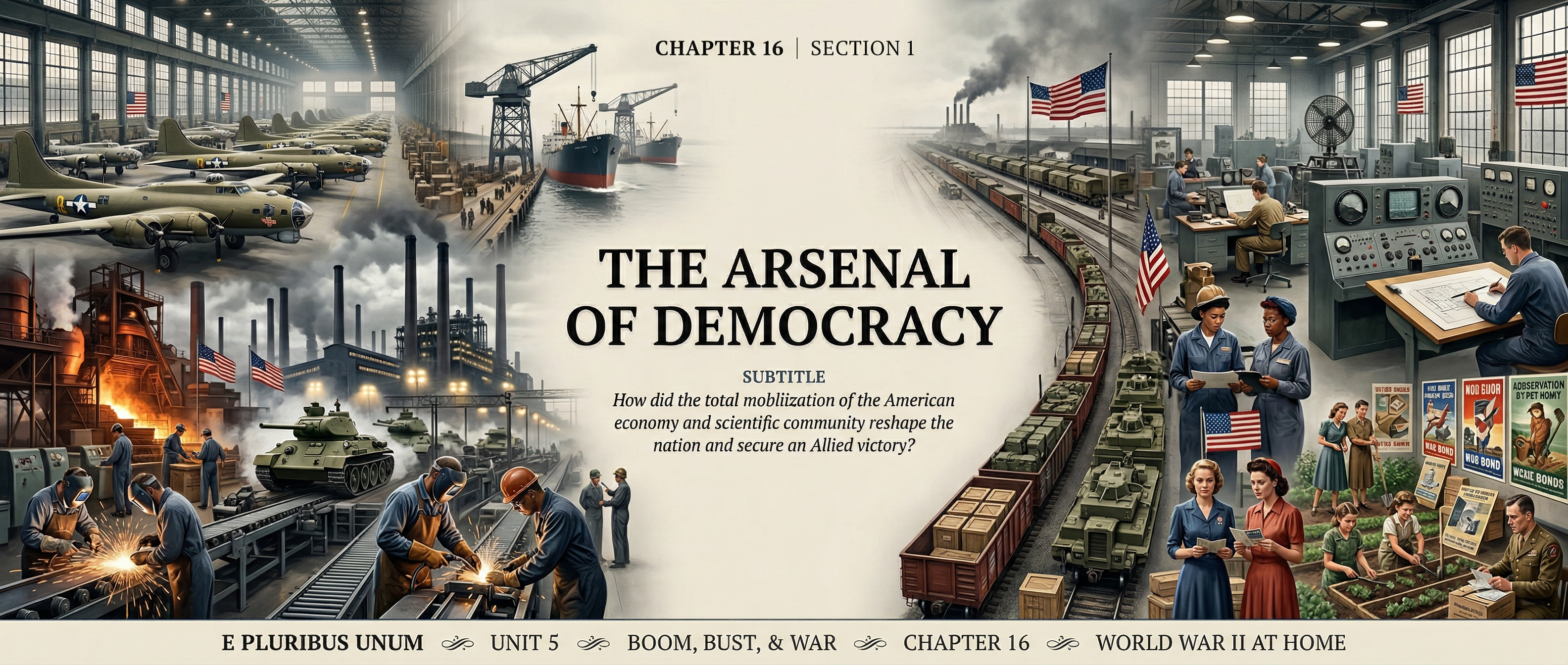
In 1940, President Franklin D. Roosevelt issued a historic call to action: the United States must become the "great arsenal of democracy." At the time, the U.S. military ranked eighteenth in the world and the economy was still recovering from the Great Depression. The war, however, did not just coincide with recovery—it caused it.
Total mobilization transformed America from a Depression-era nation into a global superpower. Through massive deficit spending, industrial conversion of civilian factories, and the coordination of the scientific community, the "war was won on the assembly line before it was won on the battlefield." This application explores the economic, scientific, and social shifts that redefined American life between 1940 and 1945.
I. Production Scenarios
Evaluate the following mobilization challenges. Based on the lecture content, select the most appropriate government response or agency outcome for each scenario.
In February 1942, civilian car production is halted. The government requires thousands of heavy tanks. Which agency has the authority to oversee this conversion?
Factory workers are making more money than ever, but civilian goods like meat and coffee are scarce. Inflation threatens to spiral. What is the solution?
U-boats are sinking Allied tonnage faster than it can be replaced. A breakthrough is needed in cargo ship construction. Who provides it?
Allied forces are preparing for D-Day. Planners need a way to prevent mass casualties from infection. What scientific breakthrough is prioritized?
With 16 million men in the military, the "Arsenal" faces a labor crisis. Who fills the high-paying industrial gap?
II. Mobilization Matrix
Compare the two primary facets of the wartime engine: the industrial machine and the scientific laboratory. Explain their roles based on the lecture.
III. Case Study: The Willow Run Wonder
1943. At the massive Willow Run plant in Michigan, workers are attempting the impossible. Henry Ford has adapted the moving assembly line to the B-24 Liberator bomber—a machine with over 300,000 parts. Skeptics claim aircraft require hand-crafted precision. Yet, every 63 minutes, a finished bomber rolls off the line. Inside, "Rosie the Riveters" work alongside those who built cars in 1941, fueled by deficit-spending contracts that have ended a decade of unemployment.
Factors of the Industrial Miracle
Final Verdict
Analyze the Willow Run achievement. Was "Victory through Volume" the most decisive factor in the war? Based on the lecture, explain how this industrial model permanently altered the relationship between American industry and the federal government.
IV. Arsenal Memo: The Military-Industrial Legacy
1945. You are an economic advisor drafting the "Post-War Mobilization Report." The war is ending, but the "warfare state" remains active.
Prompt: The Permanent Shift
Draft a memo explaining how total mobilization has transformed the nation into a global superpower. Address: the emergence of the Military-Industrial Complex, the legacy of deficit spending as an economic tool, and the social catalyst of the "Rosie the Riveter" reality. Explain why American capitalism will never return to its pre-1940 state and how industrial output became a "strategic weapon" for the coming Cold War.
Review all sections. Your progress is saved locally. Clicking "Finish" generates the final archival report.