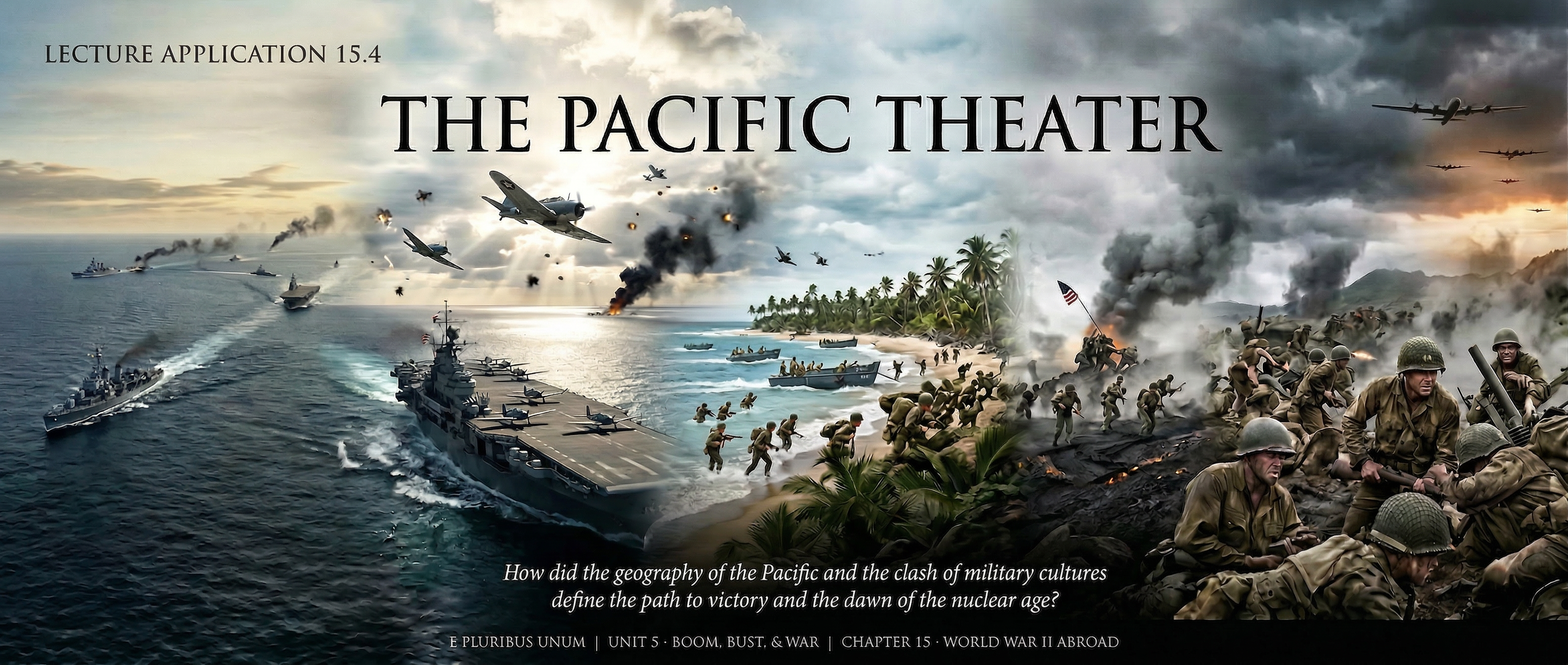
Core Objectives
- Trace the implementation of the 'Island Hopping' strategy and its cost at key battles like Midway and Okinawa.
- Analyze the influence of Japanese military culture (Bushido, Kamikaze) on combat and POW treatment.
- Evaluate the political and ethical factors in Truman's decision to use atomic weapons.
Key Terms
INTRODUCTION
The Pacific Theater was a war of distances, defined by naval supremacy and the ability to project air power across millions of square miles of ocean. Unlike the industrial warfare of Europe, victory in the Pacific required bypassing fortified island strongholds and capturing strategic airbases in a process known as "Island Hopping."
This conflict was also a profound clash of military cultures. The Japanese Bushido code, which viewed surrender as the ultimate dishonor, led to the brutal treatment of prisoners on the Bataan Death March and the desperate sacrifice of Kamikaze pilots. The war culminated in the dawn of the nuclear age, as President Harry Truman faced a decision that would reshape global history and raise enduring ethical questions about modern warfare.
I. Geographic Scenarios
Evaluate the following historical situations in the Pacific. Based on the lecture content, select the most accurate strategic or cultural outcome for each scenario.
Intelligence intercepts Japanese signals. Admiral Nimitz has the chance to set a trap. Which engagement shifts the momentum of the war?
In 1942, thousands of American and Filipino troops surrender. They are forced to march 60 miles without food or water. Why do the guards show no mercy?
Allied forces face a heavily fortified island. It has no airbase but thousands of troops. What is the 'Island Hopping' protocol?
At Okinawa, American sailors witness planes crashing directly into their ships. What does this indicate about the potential invasion of mainland Japan?
Truman is informed the Trinity Test is a success. He must choose between 'Operation Downfall' or the new weapon. What is his primary justification?
II. The Two-Path Matrix
Allied victory required two simultaneous drives across the Pacific. Compare the strategies of Nimitz and MacArthur based on the lecture.
III. Case Study: The Nuclear Choice
July 1945. President Truman sits at the Potsdam Conference. He has just received word of the Trinity Test success. Operation Downfall—the land invasion of Japan—is scheduled, with projected American casualties exceeding one million. Reports from Okinawa show that civilians and soldiers alike are jumping from cliffs rather than surrender. Japan’s home defense force is mobilizing every citizen.
Strategic Factors of the Decision
Final Verdict
Analyze Truman's decision to use the atomic bomb. Based on the cultural and geographic context provided in the lecture, was this a military necessity or a demonstration of power for the emerging Cold War? Explain your reasoning.
IV. Strategic Memo: Post-War Reconstruction
August 15, 1945. Emperor Hirohito has announced unconditional surrender. You are an advisor tasked with drafting the "Tokyo Bay Memorandum" regarding the future of occupied Japan.
Prompt: The Path to Partnership
Draft a memo proposing how to transition Japan from a "Bushido-dominated" military culture to a stable democratic ally. Address: the reconstruction of industry, the creation of a 'Peace Constitution,' and the importance of turning a former enemy into a regional partner. Reflect on how the geography of the Pacific and the trauma of nuclear warfare must be navigated to ensure lasting stability.
Review all sections. Your progress is saved locally. Clicking "Finish" generates the final archival report.