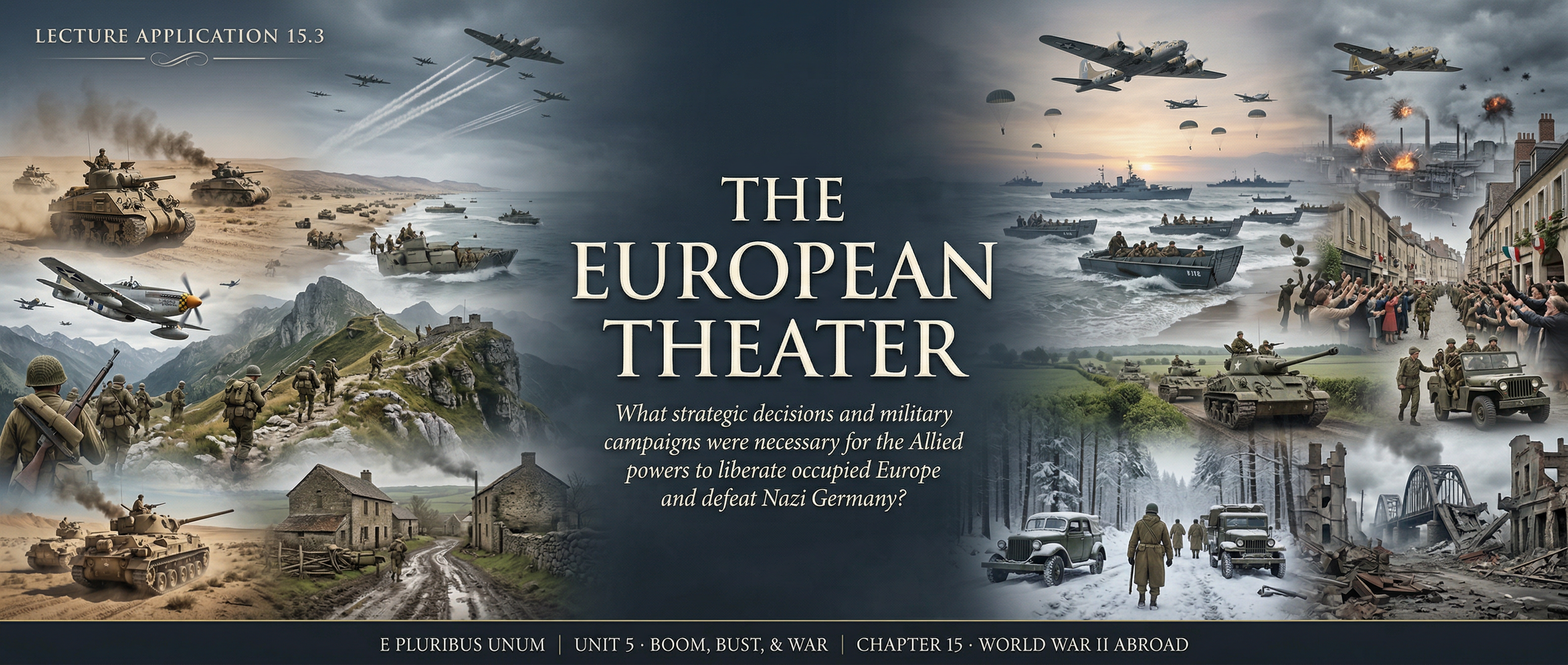
Core Objectives
- Analyze the strategic debate regarding the 'Second Front' and the significance of Operation Overlord.
- Trace the Allied advance from North Africa through Italy and across Western Europe.
- Evaluate the leadership roles of Allied commanders and the impact of strategic bombing.
Key Terms
INTRODUCTION
Victory in Europe was not a single event, but the result of a coordinated multi-stage campaign that leveraged American industrial power, Allied air superiority, and the immense sacrifice of soldiers across multiple theaters. Following the "Germany First" mandate, the Grand Alliance navigated deep internal disagreements—specifically the contentious debate over when and where to open the "Second Front" in Western Europe.
From the early training grounds of North Africa during Operation Torch to the scale-climbing heroism of Omaha Beach on D-Day, Allied forces moved from inexperience to mastery. This application will test your understanding of the strategic decisions, military campaigns, and leadership roles required to liberate occupied Europe and secure the unconditional surrender of Nazi Germany.
I. Strategic Scenarios
Evaluate the following historical turning points. Based on the lecture, select the most accurate strategic decision or outcome for each scenario.
Stalin demands an immediate cross-channel invasion of France to relieve the Red Army. Churchill advocates for a peripheral strategy in the Mediterranean. What does FDR decide?
In early 1943, inexperienced American troops are shattered by Rommel's Afrika Korps. How does the Allied command respond?
U.S. bombers are being slaughtered by the Luftwaffe on deep daylight raids. What technological breakthrough changes the air war?
Allied planners need to hide the largest invasion in history. How do they handle the Normandy planning?
In December 1944, Hitler launches a final winter offensive through the Ardennes. American troops are surrounded at Bastogne. What happens next?
II. The Air War Matrix
The "War in the Clouds" was fought using two distinct philosophies. Compare the RAF and USAAF strategies based on the lecture.
III. Case Study: "Nuts!" at Bastogne
December 1944. The 101st Airborne is surrounded in the Belgian town of Bastogne. German commanders deliver a written demand for surrender or face total annihilation by artillery. General McAuliffe responds with a single, typewritten word: "Nuts!" Outside, the weather is too fogged-in for air support, and Hitler's final reserves are pushing hard.
Strategic Factors of the Bulge
Final Verdict
Explain why Hitler's "final gamble" failed despite the initial surprise. How did American resilience at Bastogne and Patton's tactical speed turn a potential disaster into the end of Germany's offensive capability?
IV. Command Memo: The Advance to the Elbe
April 1945. You are a senior advisor to General Eisenhower. The Red Army is closing in on Berlin from the East. Allied troops are moving rapidly from the West. The Elbe River is your current strategic marker.
Prompt: The Elbe Decision
Draft a memo to Eisenhower advising him on whether to push for Berlin or halt at the Elbe. Consider: the high cost of urban warfare, the political landscape of post-war Europe, and the health of the alliance with Stalin. Mention how the "Germany First" strategy has reached its culmination and how the leadership of the new President, Harry S. Truman, should be addressed.
Review all sections. Your progress is saved locally. Clicking "Finish" generates the final report.