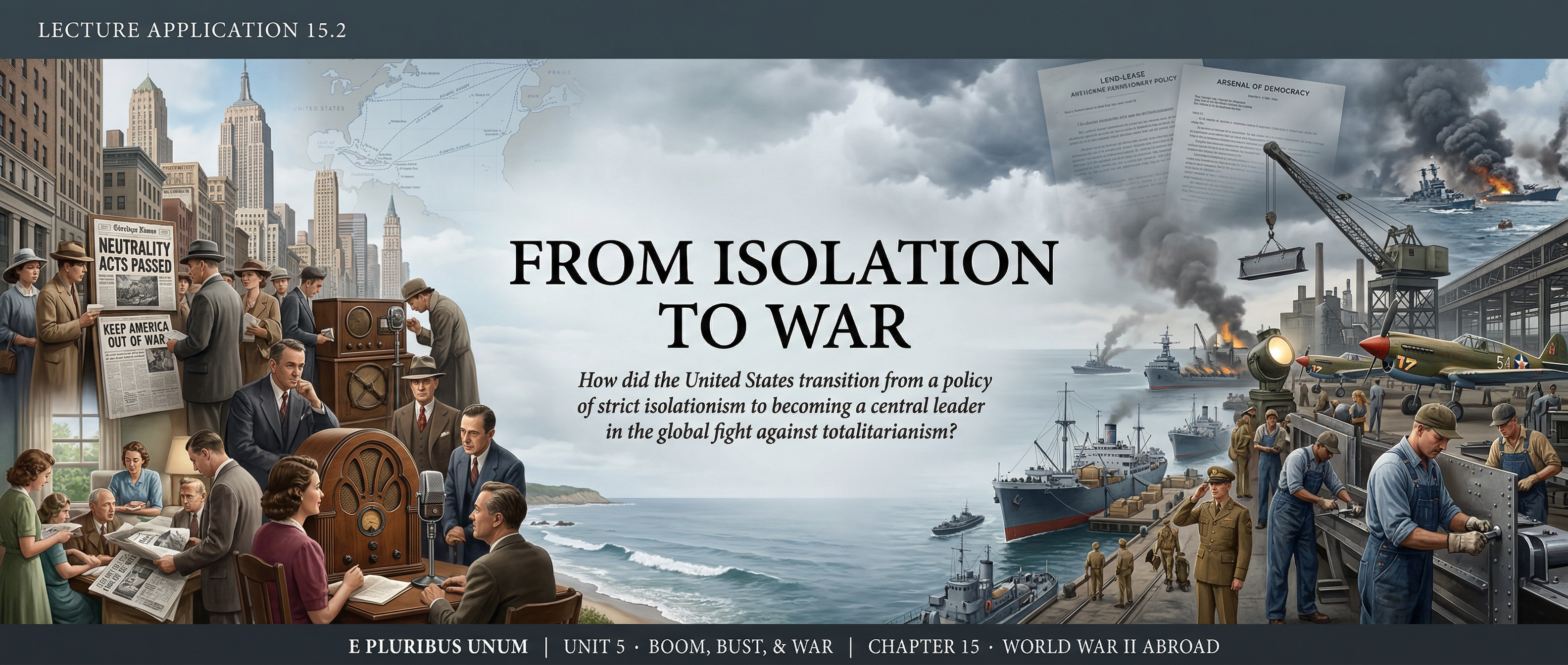
Core Objectives
- Trace the evolution of U.S. policy from the Neutrality Acts to the Atlantic Charter.
- Analyze the impact of the Pearl Harbor attack on American national unity.
- Compare the strategic goals of the "Big Three" within the Grand Alliance.
Key Terms
INTRODUCTION
The transition of the United States from a policy of strict isolationism to global leadership was not a sudden leap, but a calculated and contested evolution. Spurred by the trauma of World War I and the economic devastation of the Great Depression, many Americans initially believed that foreign entanglements were a "racket" designed to benefit wealthy "Merchants of Death."
However, as totalitarianism expanded across Europe and Asia, President Franklin D. Roosevelt navigated a delicate path. Through incremental shifts—from the Neutrality Acts to the "Arsenal of Democracy"—he prepared the American public for the reality that oceans alone could no longer guarantee safety in the modern age.
I. Policy Scenarios
Evaluate the following historical situations. Based on the lecture content regarding the shift from isolation to intervention, select the most appropriate U.S. policy or historical outcome for each scenario.
A private American manufacturer seeks to sell machine guns to Italy during their invasion of Ethiopia. Under the law at this specific time, what is the result?
Great Britain requires non-military supplies like medical bandages. They have the funds and the naval capability to protect their own transport. Which policy applies?
Britain's "house is on fire" (financial collapse) but they are the last democracy standing. How does FDR justify moving past 'Cash and Carry'?
In response to Japanese expansion into French Indochina, the U.S. implements a drastic economic measure. What is it?
Japanese aircraft appear over Oahu. Beyond the physical damage, what is the most significant political shift that occurs by noon the next day?
II. Conceptual Matrix
Contrast the two defining legislative frameworks that bookended America's path to war. Explain how each handled the following categories based on the lecture.
III. Case Study: The Arsenal Retools
"Standard Steel Works" in Ohio has manufactured luxury car frames since 1925. In late 1940, government officials arrive with blueprints for Sherman tank chassis. The owner, a former 'America First' supporter, must decide whether to accept the contract and retool the entire factory floor.
Strategic Checklist for Retooling
Final Verdict
As the factory owner, explain your decision. How does your choice reflect the transition from the "Merchants of Death" mentality of the 1930s to the "Four Freedoms" of the 1940s?
IV. Creative Application: The Grand Strategy
You have been appointed as a senior strategic advisor to the "Big Three" (Roosevelt, Churchill, Stalin) in early 1942. Your task is to draft a memo addressing the friction between the Allies while leveraging American industrial superiority.
Prompt: The Arsenal Memo
Identify one key goal for each leader (e.g., Soviet Eastern Front pressure, British naval intelligence, U.S. production) and explain how the Grand Alliance will coordinate these to overwhelm the Axis powers. Address how American production (surpassing Germany/Japan combined) will be the "decisive factor" in the post-war reconstruction goals mentioned in the Atlantic Charter.
Review all sections before final submission. Your progress is saved locally, but clicking "Finish" generates the final archival report.