Core Objectives
- Trace the rise of totalitarianism and how economic instability led to the emergence of radical regimes.
- Evaluate diplomatic failures and assess how the policy of appeasement failed to halt Axis expansion.
- Analyze military strategies, specifically the effectiveness of Blitzkrieg tactics in Europe.
Key Terms
INTRODUCTION
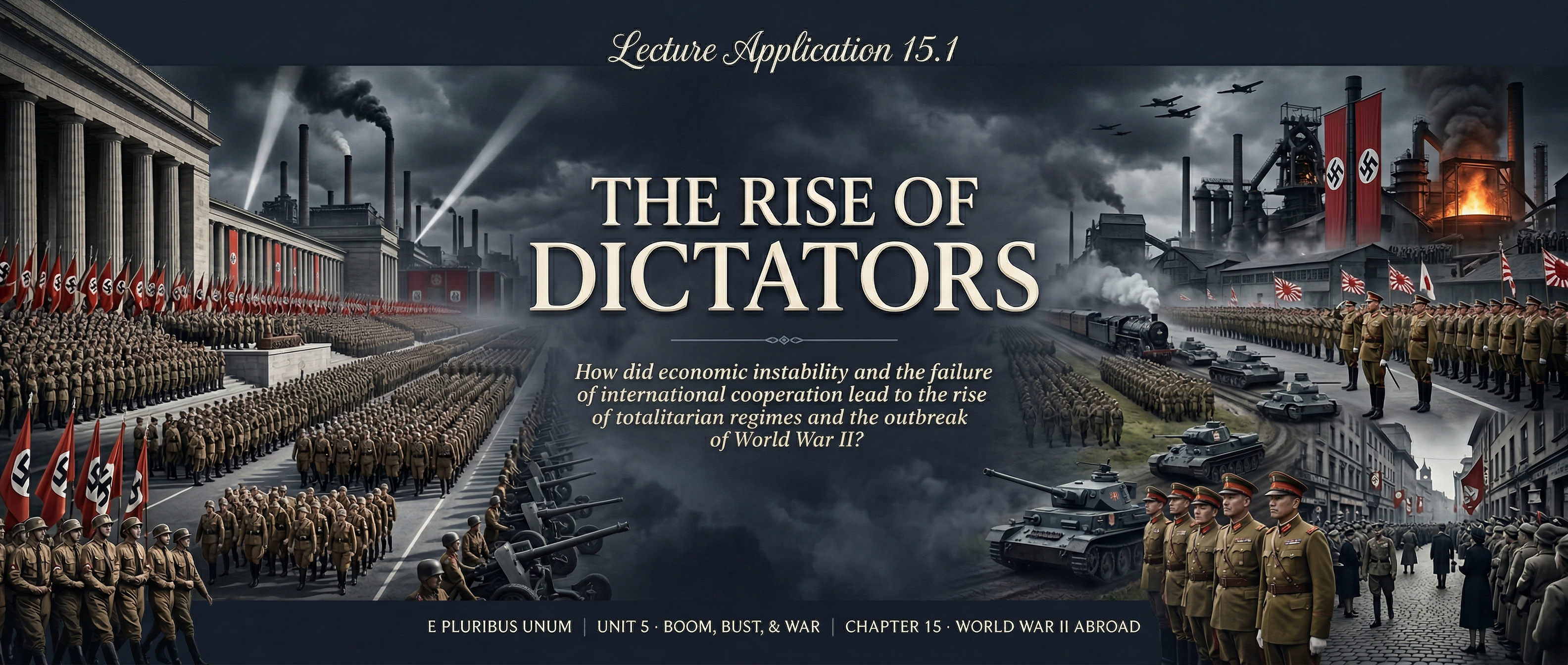
The outbreak of World War II was not an isolated event but the culmination of a global collapse in structural stability. Following the end of the Great War, the Treaty of Versailles left deep-seated resentments and economic fragile borders. This fragility exploded with the 1929 Great Depression, destroying public faith in democratic governments and creating a vacuum for radical strongmen.
In Italy, Germany, the Soviet Union, and Japan, totalitarian regimes emerged, demanding absolute obedience and regulating all aspects of public and private life. As these nations began a coordinated path of aggression, the international community's reliance on collective security and the policy of appeasement proved ineffective. This application examines the ideological roots of these dictatorships and the diplomatic failures that led the world into total war.
I. Political Scenarios
Evaluate the following historical turning points from the 1930s. Select the most accurate strategic or political outcome for each scenario based on the lecture.
Germany is struggling with hyperinflation and the 'war guilt clause.' A radical leader promises national resurrection and economic recovery. What is the primary tool used to seize absolute power?
Mussolini invades Ethiopia in 1935. The League of Nations is called upon to enforce collective security. What is the result?
Hitler sends troops into the demilitarized buffer zone between Germany and France, violating the Versailles Treaty. How do Britain and France respond?
At the Munich Conference, Neville Chamberlain agrees to Hitler's demand for the Sudetenland borderlands of Czechoslovakia. What is this policy called?
Two ideological enemies, Hitler and Stalin, sign a secret agreement to avoid a two-front war and divide Poland. What is the name of this treaty?
II. Ideology Matrix
While both were totalitarian, the regimes in Europe and Asia differed in their core justifications and methods. Compare these systems based on the lecture.
III. Case Study: The Munich Crisis
September 1938. Hitler demands the Sudetenland, a portion of Czechoslovakia. He claims it is the "last territorial demand" he will make in Europe. Neville Chamberlain travels to Munich, desperate to avoid the trench warfare horrors of WWI. No Czech representatives are invited to the meeting. Chamberlain returns to London waving a piece of paper, declaring he has secured "peace for our time." Within six months, Hitler occupies the rest of the country.
Factors of the Appeasement Failure
Final Verdict
Analyze the decision at Munich. Why did democratic leaders choose a policy that ultimately encouraged further aggression? Based on the lecture, explain how the failure of collective security at Munich made global conflict inevitable.
IV. Diplomatic Memo: The Case for Decisive Action
1936. You are a senior diplomat reporting to the League of Nations. Hitler has just remilitarized the Rhineland and Mussolini has consolidated power in Ethiopia.
Prompt: Preventing Total War
Draft a memorandum proposing how democratic nations should act to prevent the rise of further totalitarian aggression. Consider the structural roots of instability (Versailles, economic collapse) and the defining characteristics of the new dictators. Explain why "Collective Security" is failing and what specific steps must be taken to restore the "Map of Freedom" before Axis expansion leads to a general European war.
Review all sections. Your progress is saved locally. Clicking "Finish" generates the final archival report.